Founder mode for every cancer patient.
Leaving no stone unturned shouldn’t be an endurance sport.
Pavan Ramkumar, CEO
The offstage dance of cancer care
Each year, about two million people in the United States hear that they have cancer1. The first days are a blur of scans, staging, and a first plan. If the cancer is common and the stage is familiar, that plan can appear quickly: surgery, chemotherapy, radiation. Oncologists call this the standard of care: a treatment plan derived from established guidelines, and the one insurers are set up to pay for.
What is less visible, and what most families are not prepared for, is how little of the real decision-making happens in those visits.
A typical oncology appointment is short. The treating physician sees dozens of other patients, manages a queue of results for each, and interprets a guideline that already says what to do next if the case is typical. What is on stage is the visit itself: the exam, the scan review, the next order, the sentence in the guideline that fits, the routing to standard of care treatment. When the case is not typical, or when the first plan stops working, the hard work moves offstage.
The clinic’s closest form of that work is a tumor board: a scheduled meeting of specialists (medical oncology, surgery, radiation oncology, radiology, pathology) who review a difficult case and recommend a direction. The output is often a brief note in the chart. It is a real form of collective judgment, and it is also a snapshot. Access is uneven, and even when a patient has a board, it is not available at midnight when a new genomic report lands, or when a spouse finds a trial the clinic’s printout does not mention.
Between visits, the system goes quiet. The family is left with MyChart or another electronic health record portal, a date for the next appointment, and a stack of PDFs that do not explain themselves: a CLIA lab report, a radiology or imaging write-up, a molecular panel, a one-page treatment roadmap, a paragraph on prognosis. Meanwhile, the tumor shape shifts. The questions and answers that determine whether anyone looks past the guideline happen offstage. What does this forty-page molecular report actually say about this tumor? Is there a clinical trial that fits, and who is the coordinator? Is there a drug approved for a different cancer that aims at the same target? Should we sequence more deeply, and can we even get the tissue?
Mainstream oncology is not equipped to do that work for 18 million survivors in the United States alone. John Carroll, the founding editor of Endpoints News, wrote after his own rare cancer that everyday care often lags the official guidelines by a decade, and that those guidelines lag frontier science by another decade2. In one claims study, only about a third of adults with newly diagnosed advanced cancer had molecular testing documented at all: a laboratory read of the tumor’s DNA or related markers that can open a targeted drug or a trial.3 Broader DNA panels of the tumor remain unusual even among privately insured people with metastatic solid tumors4. Structured research, whether a treatment trial or even a study that banks tissue, still reaches only a small fraction of patients5.
So families cope in three ways. They research it themselves. They hire help. Or they wait.
Agency. People with time, scientific literacy, a relative in medicine, or a temperament that will not let a closed door stay closed become their own researchers. They download papers. They email trial sites. They show up to the next visit with a list of options they want considered.
Means. People who can pay hire help: concierge medical practices, care-navigation firms, scientists on contract. Those people are the fiduciaries the patient has asked to act in their interest outside the core treatment workflow: a caregiver who has become the family’s project manager, a navigator who makes the calls, a researcher who can analyze a sequencing file, a clinician who is not writing the chemotherapy orders but is willing to think.
Wait. Everyone else waits for the next appointment. That is most of the two million. What they lack is continuous attention to one person’s tumor, applied by people who are allowed to look past the guideline.
What a fully staffed team can give one case, between visits, is continuous attention to one tumor: reading the report, finding the trial, asking whether there is tissue left to sequence. Most families will never hire that team. It is worth seeing what the work looks like when someone can.
Going founder mode on cancer
In November 2022, Sid Sijbrandij, then the founding CEO of GitLab, was found to have a high-grade osteosarcoma growing out of his spine. He went through surgery, fusion, radiation, and chemotherapy intensive enough to require four blood transfusions. The cancer receded, then came back. His oncologist, whom he has been careful to praise, had nothing left with extensive evidence behind it. There was no trial that fit an adult with this rare bone cancer. In an essay for The Cancer Letter this August, Sid described that moment with a phrase borrowed from startup writing: he was default dead. If nothing else changed, he would die6.
He did not treat the end of the standard pathway as the end of the case. He stepped back from the CEO role and stayed in the details of his own case: every diagnostic he could get, every researcher who would take a call, every experimental option that could be argued from his own biology. Sid’s story is an existence proof.7 It was an expensive one to generate. He had money, friends in sarcoma research, and a habit of refusing to delegate a problem that processes had already abandoned. Most patients will never have that combination.
I’m not holding this up as a model. I’m holding it up as a proof of concept.
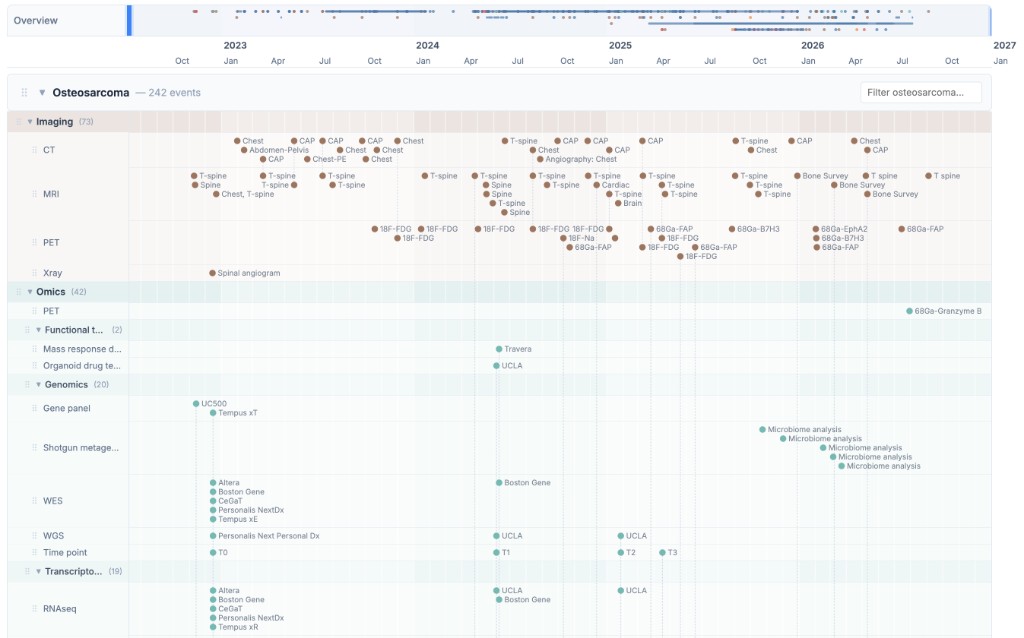
Sid kept a living document, hundreds of pages of notes that the team wrote into after every meeting, the way an open company keeps a handbook. He collected data first and decided what to do with it after. Bulk RNA sequencing of the recurrent tumor flagged unusually high expression of FAP, a protein more often discussed in fibroblasts than in bone cancer. Single-cell sequencing confirmed it was on the tumor itself. That finding opened a door the guideline did not list: a radioligand treatment in Germany that aims a radioactive payload at FAP. He went twice. The tumor necrosed and shrank enough that surgeons could take out what was left.6
He did not wait on that one bet. In parallel he ran immunotherapies, including a personalized peptide vaccine designed against his own tumor, later a custom mRNA vaccine, and a ladder of targeted drugs, most of them existing medicines used off-label or in single-patient studies. He staffed the case the way he had staffed a company: a personal version of the FDA’s Oncologic Drugs Advisory Committee (ODAC), a scientific board, and a person whose job was to run his health. The treatment timeline is on osteosarc.com, supported by about 25TB of raw data over four years released as a public resource. He has no evidence of residual disease today, about two years on.
That is founder mode applied to one tumor, but the population that needs this attention is still growing. Two costs fell far enough to change what a small team can do. It became much cheaper to measure a tumor in molecular detail, and much cheaper to run software that can read, search, and write over long documents, query knowledge sources, analyze data, and produce reports. The number of people living after a cancer diagnosis kept rising through the same years.
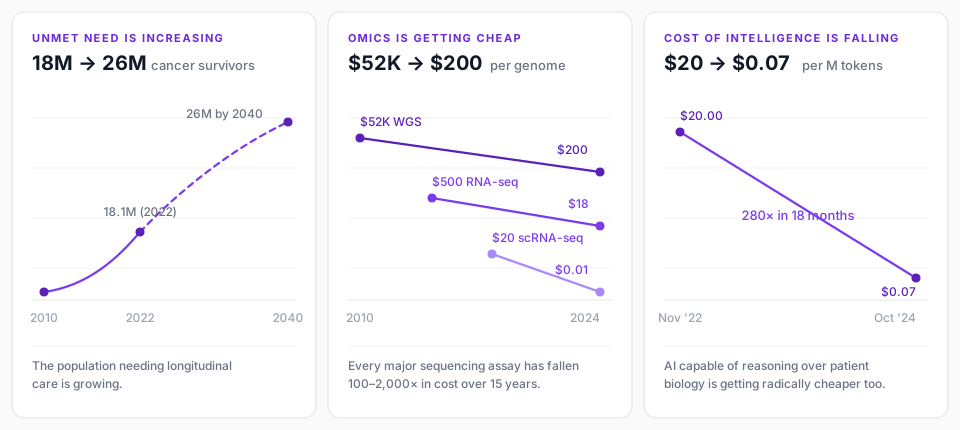
That is what makes a patient-first harness possible. Between visits, the family and the people they trust ask questions grounded in the patient’s files, bring the evidence to those questions, and run the research and analysis on those files in a workbench. The two million families who hear a diagnosis each year should not have to become the chief executive of their own care to do that.
What a patient-first harness needs
Other products already cover one of those three.
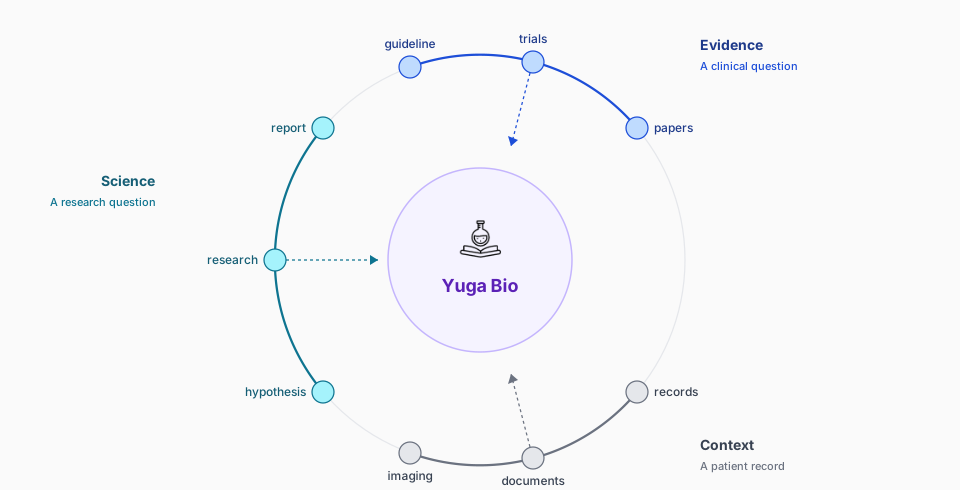
Scientists got workbenches. Phylo, OpenAI’s Rosalind Workbench, and Anthropic’s Claude Science take a research question from hypothesis to report, and they run the compute so a scientist does not have to stand up a cluster by hand. The literature can sit beside that workbench.
Clinicians got the evidence. OpenEvidence answers a clinical question from guidelines, papers, and trials.
Patients got context. Guava Health and tools like it synthesize the health record. ChatGPT Health adds a model, so a person can make sense of labs and notes and walk into an ordinary appointment with a better question.
Yuga is where a question can use all three. The EHR, the documents, the imaging, and the omics sit in a HIPAA-compliant vault the patient owns, and the question is asked against those files. Evidence is brought to that question, including diagnostic products, patient forums, and omics atlases. The research and analysis runs on the same files in the workbench.
What Yuga ships today
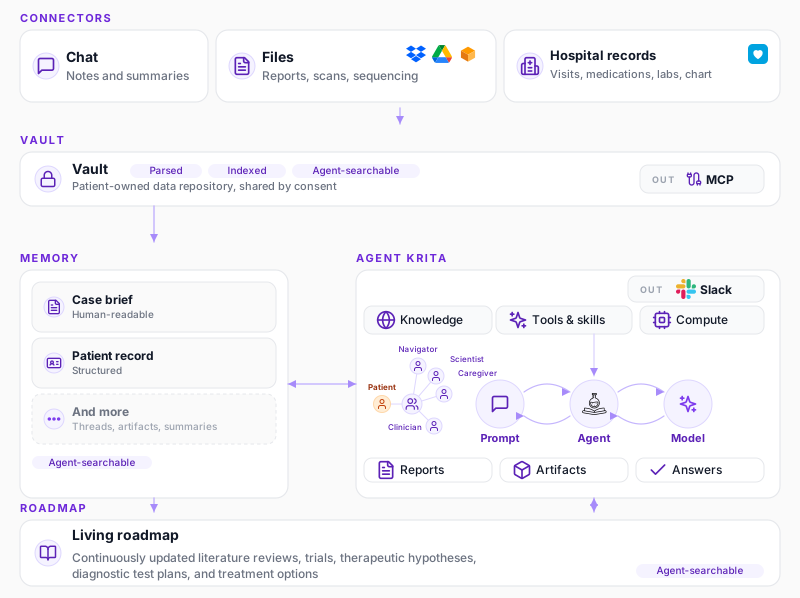
- A vault the patient owns. MyChart, CLIA reports, imaging, and genomics files, in HIPAA-compliant storage and compute.
- A team on the same case. A caregiver, navigator, clinician, or scientist joins by consent.
- Evidence lookups. Guidelines, trials, literature, diagnostic products, patient forums, and omics atlases.
- A workbench on those files. Research and analysis runs there, including when raw sequencing needs real compute. Results come back into the case, rather than as another PDF in the portal.
- Connectors in. Dropbox and Google Drive, for the files a family already keeps somewhere else.
- Connectors out. Slack, for a team that already has a room. MCP, so an assistant they already use can read the vault.
- Bring your own key. An Anthropic or OpenAI key, paid to that provider, or Yuga-billed model usage.
- A living roadmap. From this disease to the options in front of the case, updated as records and analysis land.
The visit will still be short, and the guideline will still be what insurers are set up to pay for. The work after the visit is what most of the two million never get. Until Yuga.
Yuga is generally available to patients and caregivers in the United States.
If you are a patient or a caregiver, start a case here, without hiring staff for the time between visits. If you are a navigator, a concierge clinician, or a virtual care product team, ask about a plan.
References
- Siegel RL, Giaquinto AN, Jemal A. Cancer statistics, 2025. CA Cancer J Clin. 2025. Projected 2,041,910 new invasive U.S. cases, excluding most skin carcinomas. doi:10.3322/caac.21871
- Carroll J. You bet your life: After I was diagnosed with a rare cancer, I discovered how a small band of physician-scientists triggered a revolution. Endpoints News. September 18, 2024. https://endpoints.news/after-i-was-diagnosed-with-merkel-cell-carcinoma-i-discovered-how-a-band-of-physician-scientists-triggered-a-revolution/
- DaCosta Byfield S, et al. Biomarker testing approaches, treatment selection, and cost of care among adults with advanced cancer. JAMA Netw Open. 2025;8(7):e2519963. About 35% with evidence of molecular testing; cohort 2018 to 2022. doi:10.1001/jamanetworkopen.2025.19963
- Wang X, et al. Adoption of broad genomic profiling in patients with cancer. JAMA Oncol. 2025;11(6):666-668. About 20% with broad profiling among privately insured metastatic solid tumor patients, 2020 to 2022. doi:10.1001/jamaoncol.2025.0499
- Unger JM, et al. National estimates of the participation of patients with cancer in clinical research studies based on Commission on Cancer accreditation data. J Clin Oncol. 2024;42(18):2139-2148. 7.1% treatment trials; 12.9% biorepository studies; 2013 to 2017. doi:10.1200/JCO.23.01030
- Sijbrandij S. From “default dead” to living the future of cancer care. The Cancer Letter. August 14, 2026. https://cancerletter.com/guest-editorial/20260814_2/
- Hershberg E. Going founder mode on cancer. The Century of Biology. January 18, 2026. https://centuryofbio.com/p/sid